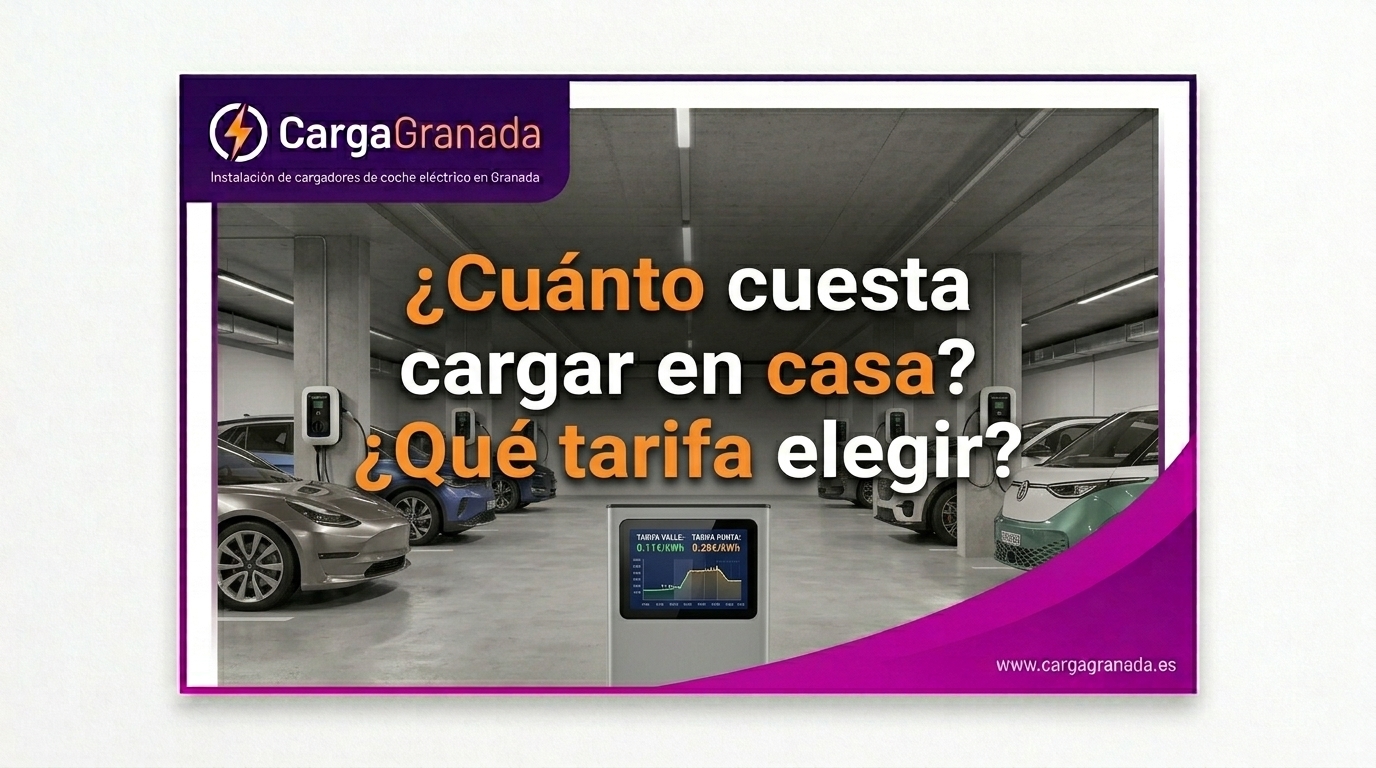
Charging an electric car at home costs, on average, between about €2.40 and €4.30 per 100 kilometres, depending on the price you pay per kWh and charging losses. The key isn't the car, it's what time you charge and what tariff you're on: charging overnight with time-of-use pricing is the cheapest option. Below you'll find the formula to work it out with your own numbers.
"How much will it cost me to charge?" is the first question almost anyone considering an electric car asks. The short answer is that it's cheaper than filling up with petrol, but how much cheaper depends on your tariff and your habits.
Let's go through the calculation step by step so you can adapt it to your own case.
The formula for working out the cost of charging #
The cost of driving 100 km depends on two things: what your car uses and what you pay per kWh.
Cost per 100 km = car's consumption (kWh/100 km) × charging losses × price per kWh
For the example we'll use reasonable figures, which you can swap for your own:
- Consumption: 17 kWh per 100 km (typical for an average electric car, though this varies a lot by model and driving style).
- Charging losses: around 10%, because not all the energy that leaves the socket reaches the battery. That's 18.7 kWh from the grid.
Table: cost by price per kWh #
| Price per kWh (excl. taxes) | Cost per 100 km | Cost per year (12,000 km) |
|---|---|---|
| €0.13/kWh (off-peak) | ≈ €2.43 | ≈ €292 |
| €0.19/kWh (standard) | ≈ €3.55 | ≈ €426 |
| €0.23/kWh (peak) | ≈ €4.30 | ≈ €516 |
Prices are examples based on free-market offers with three time bands seen in October 2026 (off-peak ≈ €0.129, standard ≈ €0.189, peak ≈ €0.229/kWh, excl. taxes). Your final bill will include VAT, the electricity tax and other items, and your own prices will differ.
What the table shows is that the same charge can cost almost twice as much depending on the time you do it. Hence the importance of the tariff.
Which tariff to choose for charging at home #
Time-of-use tariff #
The 2.0TD tariff, the one most homes are on, splits the day into three bands: peak, standard and off-peak. Off-peak is the cheapest and covers the early hours of the morning (00:00 to 08:00 on working days) as well as weekends and public holidays.
If you charge at night, the cost drops noticeably. It's the tariff that almost always pays off if the car spends the night at home.
PVPC or the free market #
- PVPC (regulated hourly tariff): the price changes every hour based on the market. It can be very cheap at certain times and expensive at others.
- Free market: a price agreed with your supplier, sometimes fixed, sometimes with time bands. There are offers with a special off-peak price aimed at people who charge overnight.
There's no one-size-fits-all answer. Compare your actual consumption, factor the car into the calculation, and review it again from time to time, because prices change.
Contracted power matters too #
If you charge at 7.4 kW and have low contracted power, you either limit the charge or need to increase it, which pushes up the fixed part of your bill. In our guide on what a wallbox is and what power you need we explain how to adjust this without overpaying.
Want to know how much it would cost you?
We help you size the power and schedule your charging so you pay the least possible.
Free site visit · Reply within 24 hours
Charging at home or at a public point #
Charging at home is usually the cheapest option, because you pay your domestic tariff and can take advantage of off-peak hours. Public charging points tend to charge more, especially fast chargers, and prices vary a lot between operators.
That's why almost every driver who can charges at home: it's convenient (you leave each morning with the car ready) and it's the most economical option. If you live in a block of flats, we cover that in our community garage charger guide.
Mini calculator: do it with your own numbers #
With pen and paper, in three steps:
- Check your car's consumption (kWh/100 km) on the on-board computer or the technical spec sheet.
- Multiply by 1.1 to account for charging losses.
- Multiply by the price per kWh you pay at the time you charge. That gives you the cost per 100 km.
For the annual cost, multiply by your yearly mileage and divide by 100.
How to cut your charging bill #
These habits have the biggest effect:
- Schedule charging during the off-peak band from the car or the wallbox.
- Don't always charge to 100% if you don't need to: you save on losses and look after the battery.
- Make the most of weekends, when the whole day is off-peak.
- If you have solar panels, charge with your surplus during sunny hours (we cover this in a dedicated guide on batteries and self-consumption).
- Review your tariff once or twice a year.
What's more, installing the charging point may entitle you to an IRPF (personal income tax) deduction if you finish before the end of 2026. We explain the conditions in our guide to the 15% IRPF deduction.
If you want to know what the installation itself costs, see the price of installing a charger in Granada or our home EV charger page.
Get a quote for your installation
Fixed quote in writing, free site visit, and a reply within 24 hours.